
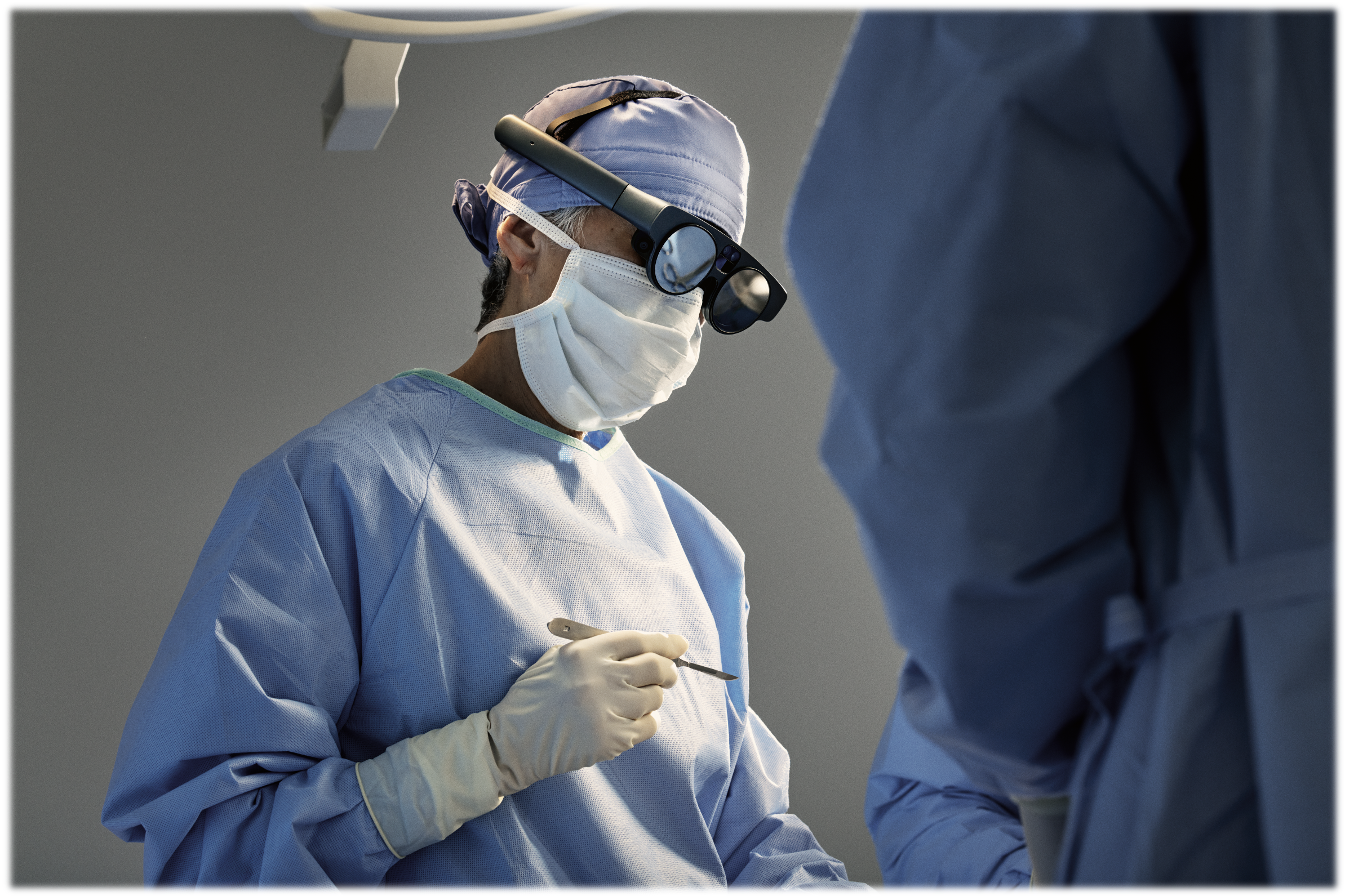
Immersive technologies in medicine, from haptic surgical rehearsal to the first AR headset certified for the operating theatre.
Medical expertise is scarce, located, and expensive to move. A surgeon's judgement is built over years and can only be demonstrated where that surgeon physically stands.
Everyone else reads about it, watches a recording, or waits for a place at the table. Complex anatomy is taught in two dimensions and recalled poorly. Rare procedures are practised rarely, because for a long time the only place to practise them was on a patient.
Cadaveric facilities are limited, costly and unevenly distributed. The constraint is not knowledge and it is not imaging. Both exist in quantity. The constraint is the transfer of judgement, from the people who hold it to the people who need it, at the speed the profession actually requires.
Immersive technology changes the modality rather than the content.
A trainee walks around a virtual patient and rehearses a knee procedure with force feedback delivered through haptic gloves and instruments. A specialist sees through a colleague's eyes in another country and guides their hands in real time. Anatomy that once needed a lab is held in three dimensions on a tablet.
The stack underneath is unremarkable: mixed reality, cloud rendering, spatial audio, haptics, sensor feeds. In January 2023 the Magic Leap 2 cleared IEC 60601-1, the first augmented reality headset certified for use in an operating theatre.
Beyond training, the talk covered remote assistance, mental health, phobia treatment and pain management.
The imaging exists. The data exists. The judgement does not travel.
Key Audience Takaways
What immersive technology actually consists of, stripped of vendor language: mixed reality, cloud rendering, spatial audio, haptics, and sensor feeds from the patient and the room
Where it is already in clinical use rather than pilot — surgical rehearsal, remote procedural guidance, remote assistance, mental health, phobia treatment and pain management
What certification changed. IEC 60601-1 moved augmented reality out of the training room and into the operating theatre
How to test a supplier's claim against the five elements above, and know which of them a given product actually delivers
Formats
Available as: 45-minute Keynote | Panel Contribution | Executive Briefing